
On this page
- 1. Our Editorial Principles
- 2. Editorial Scope and Coverage
- 3. How We Select Topics
- 4. The DCP Editorial Workflow
- 5. Source Standards and Attribution
- 6. Editorial Standards for Software Reviews
- 7. Original Research and Statistics
- 8. AI-Assisted Research and Content Production
- 9. Commercial Relationships and Conflicts of Interest
- 10. Corrections and Editorial Challenges
- 11. Updates, Dates, and Version History
- 12. Images, Graphics, and Data Visualization
- 13. Editorial Questions and Contact
This policy defines editorial standards and responsibilities. It does not establish that every procedure has already been implemented across existing content. Claims of independent review, direct testing, or completed verification require supporting records.
Digital Credential Platforms (DCP) publishes research, software reviews, rankings, comparisons, and educational content covering digital credential technology.
Our editorial purpose is to make complex software categories easier to understand and evaluate through evidence-based reporting, practical analysis, and clear explanations of product capabilities and limitations.
This policy sets out standards for how DCP selects topics, conducts research, prepares articles, reviews conclusions, manages conflicts of interest, and corrects published information.
It applies to editorial articles, platform profiles, rankings, comparisons, research reports, and other content published under the DCP name.
1. Our Editorial Principles
Accuracy
Factual claims should be supported by relevant, identifiable evidence.
Product specifications, pricing, technical capabilities, regulatory requirements, and numerical claims require particular care because inaccuracies can materially affect decisions.
Transparency
We aim to distinguish facts, editorial judgments, reported experiences, and unverified claims.
Research limitations, material commercial interests, and relevant methodological assumptions should be disclosed where they affect how content is interpreted.
Editorial accountability
Responsibility for published content remains with the publication, including when external contributors, automation, or AI-assisted workflows are used.
Technology may support research and production, but it does not replace accountability for published conclusions.
Fair comparison
Products should be evaluated against criteria appropriate to the subject and intended audience.
Differences in evidence quality, product availability, and assessment scope should be acknowledged.
Reader usefulness
We prioritize substantive information over promotional language, unsupported superlatives, and unnecessary complexity.
A useful article should help readers understand a problem, evaluate evidence, or make a better-informed decision.
2. Editorial Scope and Coverage
DCP covers developments relevant to digital credential technology and its adoption.
Our editorial areas include:
| Content category | Editorial purpose |
|---|---|
| Platform reviews | Assess individual products, capabilities, limitations, and suitability |
| Software comparisons | Explain differences between relevant solutions |
| Rankings and shortlists | Evaluate eligible products against a defined decision context |
| Technical explainers | Make standards, verification, interoperability, and implementation concepts understandable |
| Industry reporting | Cover significant developments affecting credential technology |
| Research reports | Present original or secondary research with appropriate methodological documentation |
| Practical guides | Explain operational processes and implementation considerations |
Articles may combine more than one format, but their purpose and evidentiary basis should remain clear.
For example, a reported product announcement is not equivalent to an independently verified product test, and an editorial shortlist is not equivalent to a comprehensive market study.
3. How We Select Topics
Editorial planning begins with reader problems and material developments in the market.
Topics may arise from:
- Questions encountered by software buyers and credential program operators.
- Changes to credentialing standards and technical requirements.
- New products, integrations, and industry developments.
- Common implementation difficulties.
- Gaps or inconsistencies in existing software information.
- Research findings that warrant further explanation.
- Factual corrections or meaningful reader feedback.
Search demand may help identify questions readers are asking, but search visibility alone should not determine an article’s recommendations or conclusions.
Before commissioning content, DCP should establish its purpose, intended audience, research scope, and the evidence needed to support its principal claims.
4. The DCP Editorial Workflow
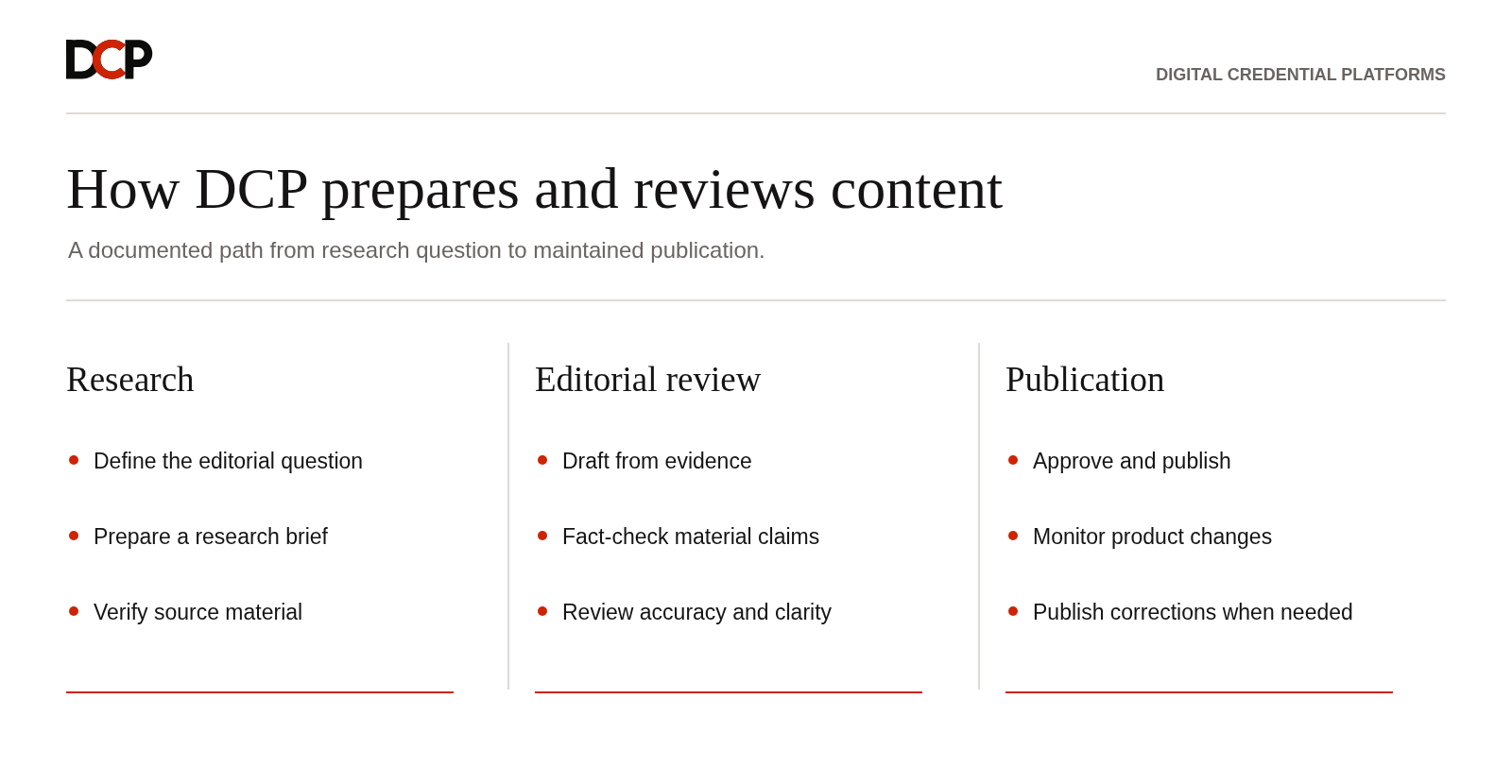
Step 1 – Define the editorial question
Every substantive piece of content should begin with a clear editorial question.
For example:
- What distinguishes Open Badges 3.0 from earlier credential formats?
- Which software capabilities matter for universities issuing digital diplomas?
- How do certificate platforms differ in bulk issuance and automation?
- What should an organization evaluate before selecting a credential verification provider?
The purpose is to identify the decision or information need that the article should address.
Step 2 – Prepare a research brief
The brief should establish:
- The intended audience.
- The main question and scope.
- The type of article being produced.
- Required sources and evidence.
- Important terminology and technical distinctions.
- Potential conflicts of interest.
- Known uncertainties and questions requiring verification.
For comparative content, the brief should also establish eligible products and the applicable evaluation framework.
Step 3 – Research the subject
Researchers should collect information from sources appropriate to the topic.
Preferred sources include official standards documentation, product documentation, technical specifications, recognized industry bodies, primary research, and reputable reporting.
Sources should be assessed for authority, specificity, currency, and potential conflicts.
A source being widely quoted does not, by itself, establish that its claims are accurate.
Step 4 – Verify material claims
Claims capable of influencing a reader’s purchasing or implementation decision should receive additional scrutiny.
These may include:
- Product functionality and restrictions.
- Prices, usage limits, and commercial terms.
- Compliance or certification claims.
- Security and verification capabilities.
- Technical integrations.
- Research statistics and survey findings.
- Significant competitive comparisons.
Where verification is incomplete, the article should qualify the claim, identify its source, or omit it.
Step 5 – Draft with evidence and context
Editorial content should explain not only what is known, but why it matters.
Reviews and comparisons should identify meaningful strengths, limitations, and tradeoffs rather than reproduce vendor marketing descriptions.
Articles should distinguish between factual reporting and editorial interpretation.
Headlines and summaries must accurately represent the content and should not exaggerate findings.
Step 6 – Review for factual accuracy
Before publication, a substantive review should check factual claims, source references, product names, dates, calculations, and descriptions of technical standards.
For ranking content, the review should also confirm that criteria, weights, individual scores, and final results agree.
A reviewer must not imply direct testing when the assessment relies only on published documentation.
Step 7 – Review for editorial quality
Content should be evaluated against five standards:
| Standard | Review question |
|---|---|
| Accuracy | Are important claims supported and correctly represented? |
| Depth | Does the piece address the subject beyond surface-level description? |
| Clarity | Are technical concepts explained without misleading simplification? |
| Relevance | Does the material answer the reader’s actual question? |
| Balance | Are material limitations, alternatives, and tradeoffs acknowledged? |
Content that fails these standards should be revised or held from publication.
Step 8 – Review presentation and functionality
Before publishing, the page should be checked for:
- Accurate headings and summaries.
- Working sources and internal links.
- Correct tables, graphics, and captions.
- Consistent product names and terminology.
- Appropriate disclosures.
- Readability across common screen sizes.
- Functional comparison elements and relevant tools.
Visual presentation should clarify the evidence, not create an impression of scientific precision unsupported by the underlying research.
Step 9 – Approve publication
Every article must have an accountable human publisher or editor who confirms that the required checks have been completed.
Where independent editorial review is available, it should be used for high-impact research, rankings, technical claims, and sensitive topics.
Where one person performs multiple editorial roles, the required checks still apply and should be documented rather than represented as independent review.
Step 10 – Monitor and maintain
Publication is not the end of the editorial process.
Content may require review when new evidence emerges, products change, standards evolve, or credible corrections are received.
Material updates should reflect actual research or verification rather than merely resetting publication dates.
5. Source Standards and Attribution
DCP distinguishes between primary and secondary information sources.
Primary sources include official product documentation, applicable standards, original datasets, direct observations, and statements attributable to the responsible organization.
Secondary sources include established reporting, independently published research, professional commentary, and appropriately contextualized customer experiences.
Primary sources are preferred for establishing a vendor’s published capabilities or contractual terms.
Independent sources are particularly valuable for corroboration, market context, conflicting accounts, and claims a vendor cannot verify about itself.
DCP should not cite a source as proof of a claim that the source does not actually establish.
Anonymous and unattributed information
Anonymous information should be approached cautiously.
Material claims based on anonymous sources require a clear editorial reason for protecting the source and a defensible basis for evaluating the information.
Unattributed promotional statements and unverifiable anecdotes should not serve as the sole basis for consequential product rankings or allegations.
6. Editorial Standards for Software Reviews
Software reviews should be structured around the capabilities and limitations most relevant to their intended audience.
A review should identify, where appropriate:
- Product purpose and positioning.
- Relevant customers and use cases.
- Core functionality.
- Pricing and notable restrictions.
- Implementation considerations.
- Verification and interoperability capabilities.
- Integrations and administrative controls.
- Material limitations and alternatives.
- Source and verification dates.
The review should distinguish available product evidence from direct testing.
For numerical assessments, the applicable scoring methodology should be identifiable and consistently applied.
A review must not rely solely on the vendor’s own marketing language as its editorial conclusion.
7. Original Research and Statistics
Original research requires additional methodological transparency.
Where DCP publishes surveys, datasets, quantitative reports, or market estimates, the accompanying information should explain:
| Research element | Expected disclosure |
|---|---|
| Research question | What the investigation intended to establish |
| Population | Who or what the findings concern |
| Sample | How many observations or respondents were included |
| Recruitment | How participants or records were selected |
| Fieldwork period | When the information was collected |
| Method | How responses or observations were gathered |
| Analysis | How calculations and conclusions were produced |
| Limitations | Sampling bias, missing information, uncertainty, and other constraints |
Statistical claims must not be invented, extrapolated beyond their supporting evidence, or presented as representative of a population without adequate justification.
Research reports should distinguish observations from interpretations.
Where original source records cannot be verified, DCP should reconsider whether the associated findings can responsibly remain published as original research.
8. AI-Assisted Research and Content Production
DCP may use artificial intelligence and automation to support research and editorial workflows.
Potential applications include organizing sources, preparing research outlines, identifying unanswered questions, assisting with drafts, reviewing language, and highlighting inconsistencies.
AI-generated information is not independently verified evidence.
All material factual claims introduced or modified through AI-assisted processes must be checked against suitable sources before publication.
Editorial controls
AI tools must not be treated as authoritative sources for product facts, technical requirements, statistics, quotations, or research findings.
Automated workflows must not invent tests, interviews, survey participants, customer experiences, or source references.
AI assistance does not replace human responsibility for verifying information, applying scoring rules, managing conflicts, or approving publication.
Where AI meaningfully affects the production of research, DCP should provide disclosure when required by law, relevant policy, or the nature of the material.
9. Commercial Relationships and Conflicts of Interest
DCP may have commercial relationships with organizations operating in the markets it covers.
These may include advertising, affiliate commissions, sponsorships, listing services, or other business arrangements.
Readers should be able to distinguish editorial assessments from paid promotional content.
Editorial safeguards
The following standards govern commercial influence:
- Commercial payments must not be treated as evidence of product quality.
- Sponsored or paid promotional material must be clearly identifiable.
- Vendors may submit corrections and documentation but must not determine editorial conclusions.
- Material professional, financial, or ownership relationships that could affect the interpretation of coverage must be disclosed where relevant.
- Individuals with a material conflict should not exercise unchecked control over the evaluation of the affected product.
A commercial relationship does not automatically invalidate an editorial assessment. But it does require appropriate disclosure and safeguards.
Claims of independence should describe actual editorial governance rather than simply imply an absence of financial relationships.
10. Corrections and Editorial Challenges
DCP welcomes credible corrections from readers, software providers, researchers, and other interested parties.
Corrections should be evaluated according to their evidentiary merit.
Types of corrections
| Category | Examples | Editorial response |
|---|---|---|
| Factual correction | Incorrect pricing, discontinued feature, wrong standards claim | Verify and update the underlying fact |
| Material assessment correction | Error affecting a score, ranking, or recommendation | Reassess the relevant evaluation and document the change |
| Contextual clarification | Technically correct information that creates a misleading impression | Add or revise explanatory context |
| Routine update | New feature, changed plan, updated documentation | Review for inclusion in the maintenance cycle |
| Editorial disagreement | Different interpretation without evidence of factual error | Consider the argument; revision is not automatic |
When a material correction changes an article’s conclusion, score, or recommendation, the change should be made visible to readers.
Minor typographical and formatting corrections generally do not require a formal correction notice.
DCP should not silently remove material evidence of a published error to create a misleading publication record.
11. Updates, Dates, and Version History
Published content may display creation, update, and verification dates.
These dates have different meanings.
Published: The date the content was first made publicly available.
Updated: The date a substantive editorial or factual change was published.
Last verified: The date significant underlying claims or product information were last checked.
A page should not be marked as recently verified when only its formatting, metadata, or presentation has changed.
Where a revised methodology materially alters existing scores or rankings, the applicable framework version should be identified.
Substantive corrections and methodology revisions may warrant a visible change record.
12. Images, Graphics, and Data Visualization
Charts, screenshots, diagrams, and graphics should accurately represent the information they communicate.
Charts should identify relevant units, time periods, sources, and important limitations.
Screenshots should reflect identifiable product versions or research conditions where those details affect interpretation.
Illustrative graphics must not be represented as actual experimental or statistical results.
AI-generated illustrations may be used where appropriate, but synthetic images should not be passed off as documentary evidence of product behavior, real people, or research activity.
Branding and visual design do not substitute for source attribution.
13. Editorial Questions and Contact
Readers, researchers, and software providers may raise editorial questions, request factual corrections, or submit documentation for consideration.
Please contact:
hello@digitalcredentialplatforms.com
For a correction request, include the relevant article URL, the statement in question, and supporting evidence.
DCP may update this Editorial Policy as its publishing operations and research practices develop. Material policy changes should be reflected in the published version.