
On this page
- 1. Scoring Framework Overview
- 2. Evaluation Dimensions
- 3. The DCP Rating Scale
- 4. Score Calculation
- 5. Evidence Requirements for Scoring
- 6. Source Reliability and Confidence
- 7. How User Reviews Affect Scores
- 8. Rankings and Category Context
- 9. Treatment of Commercial Relationships
- 10. Score Updates and Re-evaluations
- 11. Requests for Review or Correction
- 12. Interpreting DCP Scores
This model defines how a DCP score is to be calculated. It must not be assumed to underlie an existing rating unless that rating has been checked against the documented criteria, evidence requirements, and weights. The calculation example below is hypothetical.
The DCP scoring model defines a structured, weighted assessment of capabilities relevant to digital credential programs.
Our scoring framework is intended to make software comparisons more consistent, explainable, and useful to buyers.
This page describes the DCP Credential Platform Scoring Model, including evaluation dimensions, rating scales, weighting, evidence requirements, calculation rules, and the treatment of incomplete information.
Scores represent editorial assessments of available evidence at a particular point in time. They are not guarantees of product performance or substitutes for organization-specific evaluation.
For details about evidence collection, see our Research Methodology.
1. Scoring Framework Overview
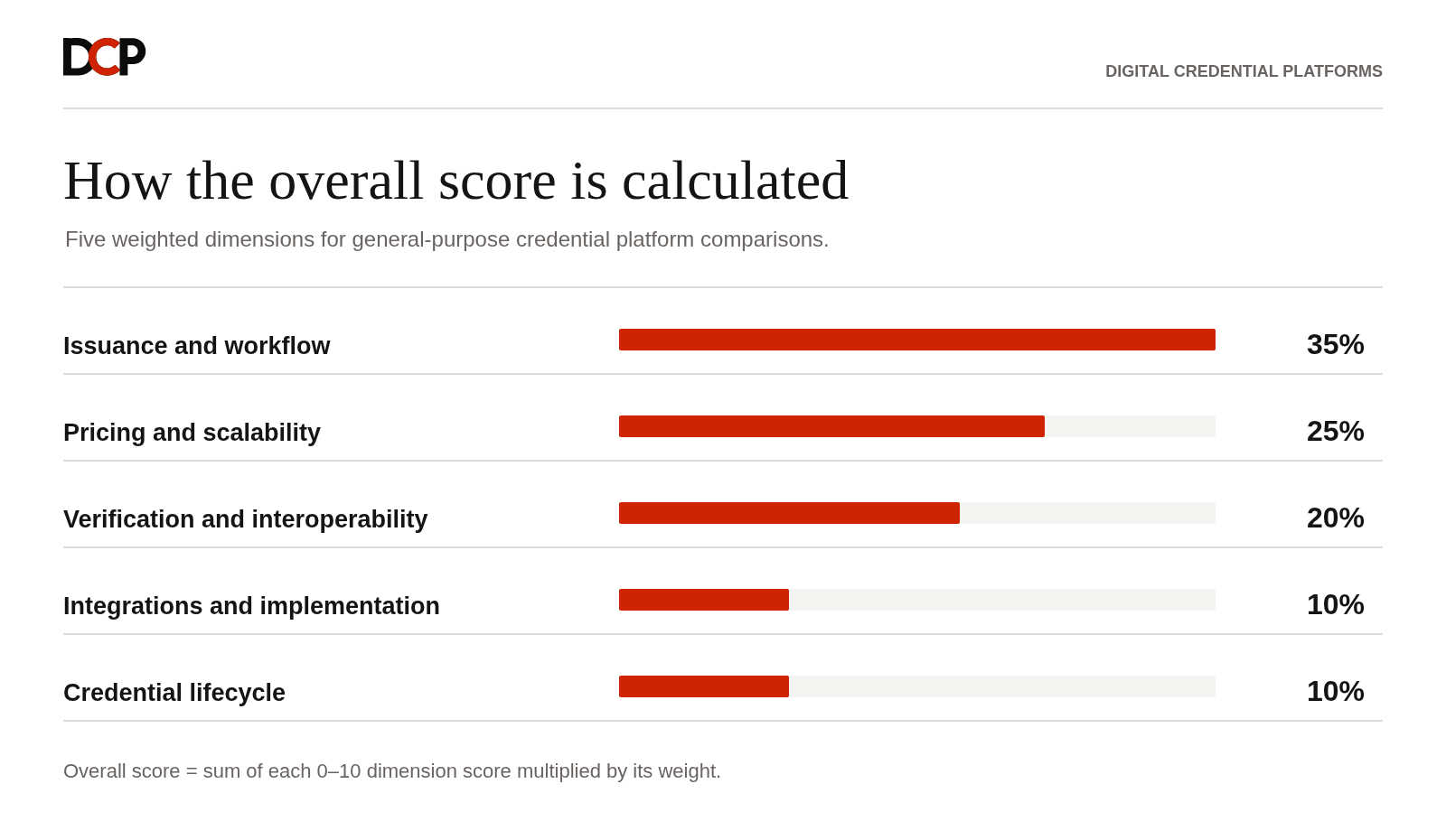
The model uses five weighted evaluation dimensions.
| Evaluation dimension | Weight | Core question |
|---|---|---|
| Issuance and workflow | 35% | How effectively does the platform support creating, issuing, and delivering credentials? |
| Pricing and scalability | 25% | How accessible and sustainable is the platform for the intended program? |
| Verification and interoperability | 20% | How effectively can credentials be verified, shared, and used outside the issuing system? |
| Integrations and implementation | 10% | How well does the product connect to existing operational systems? |
| Credential lifecycle | 10% | How effectively can organizations manage credentials after issuance? |
| Total | 100% |
The weight distribution reflects the practical importance of credential issuance, program economics, trustworthy verification, and long-term operations in a general-purpose credential platform evaluation.
These are editorial weights, not statistically established measurements of universal buyer preferences.
Different research categories may require different weights. Any category-specific variation should be defined and disclosed before evaluations are calculated.
Scores created under different weighting models should not be presented as directly comparable without qualification.
2. Evaluation Dimensions
2.1 Issuance and Workflow – 35%
This dimension examines the platform’s ability to support the core work of a credential issuing organization.
Assessment areas include:
- Credential creation and template customization.
- Individual and bulk issuance.
- Recipient import and data mapping.
- Automated issuance workflows.
- Recipient delivery and access.
- Administrative usability and workflow flexibility.
- Support for different credential types.
- Controls for high-volume or recurring programs.
A high score requires evidence that the platform can address a broad range of relevant issuance requirements with manageable operational complexity.
A limited product may still score well in a narrowly defined use case, provided that the comparison makes its scope clear.
2.2 Pricing and Scalability – 25%
This dimension assesses the relationship between cost, functional access, and operational scale.
Researchers consider:
- Public pricing and contractual transparency.
- Free or introductory plan availability.
- Issuance limits and usage allowances.
- Additional recipient, credential, or administrator costs.
- Feature restrictions across plans.
- Contract duration and billing flexibility.
- Cost implications of increasing issuance volume.
- Enterprise pricing or minimum commitments, where documented.
Price is evaluated in the context of the intended buyer.
The lowest advertised subscription price does not necessarily represent the lowest total cost of running a credential program.
Where pricing is available only through a sales enquiry, DCP should identify that limitation rather than estimate a contract price without evidence.
2.3 Verification and Interoperability – 20%
This dimension considers how recipients and third parties can establish credential authenticity and use credentials outside the issuing platform.
Assessment areas include:
- Public credential verification.
- Credential metadata and issuer identification.
- Support for applicable credential standards.
- Independent certification where relevant.
- Recipient portability and sharing.
- Verification after credential changes.
- Credential export and interoperability.
- Revocation status visibility.
DCP distinguishes claimed standards compatibility from independently demonstrated or certified compliance.
A proprietary verification URL may be useful but should not automatically receive the same assessment as verified support for an open, interoperable credential format.
2.4 Integrations and Implementation – 10%
This dimension examines operational compatibility with other software and systems.
Relevant areas include:
- Native learning management system integrations.
- Workflow automation platforms.
- Public APIs and developer documentation.
- Webhook and event capabilities.
- Administrative and identity-related integrations.
- Implementation guidance.
- Data import and export capabilities.
- Relevant implementation limitations.
An integration’s existence does not establish the quality or depth of its functionality.
Where possible, DCP distinguishes between a documented integration, a third-party connector, a custom implementation, and a directly verified workflow.
2.5 Credential Lifecycle – 10%
This dimension covers the management of credentials after initial issuance.
Assessment areas include:
- Credential expiry and renewal.
- Revocation and status management.
- Corrections and reissuance.
- Recipient record management.
- Reporting and auditability.
- Long-term accessibility.
- Program administration.
- Data retention and export controls where relevant.
Features are assessed according to their demonstrated or documented contribution to ongoing credential program management.
A product’s lifecycle score should not rely solely on the quantity of features advertised.
3. The DCP Rating Scale
Each dimension is assessed on a 0-10 scale.
The model uses defined rating anchors to reduce arbitrary interpretation.
| Score range | Interpretation |
|---|---|
| 0-1.9 | Capability is demonstrably absent or materially inadequate for the evaluated use case |
| 2.0-3.9 | Limited capability with substantial functional restrictions |
| 4.0-5.9 | Basic or partial support for the evaluated requirements |
| 6.0-7.9 | Substantial support with identifiable limitations or tradeoffs |
| 8.0-9.4 | Strong documented coverage of the evaluated requirements |
| 9.5-10.0 | Exceptional coverage relative to the defined rubric, supported by strong evidence |
These anchors establish the general interpretation of scores.
For greater repeatability, each dimension should also have a documented set of individual requirements and scoring guidelines.
A numerical rating must be traceable to evidence and a reasoned assessment.
A score of 10 does not mean a product is perfect, and no product is guaranteed to receive the highest rating.
4. Score Calculation
The overall score is calculated as the weighted sum of the five dimension scores.
Formula:
Overall score = (Issuance x 0.35) + (Pricing x 0.25) + (Verification x 0.20) + (Integrations x 0.10) + (Lifecycle x 0.10)
All individual dimension scores use the same 0-10 scale.
Illustrative calculation
The following is a hypothetical example, not a score assigned to any actual product.
| Dimension | Score | Weight | Contribution |
|---|---|---|---|
| Issuance and workflow | 8.0 | 35% | 2.80 |
| Pricing and scalability | 7.0 | 25% | 1.75 |
| Verification and interoperability | 6.0 | 20% | 1.20 |
| Integrations and implementation | 8.5 | 10% | 0.85 |
| Credential lifecycle | 7.5 | 10% | 0.75 |
| Overall | 100% | 7.35 |
The illustrative overall score would be published as 7.4/10, rounded to one decimal place.
The calculation is intentionally straightforward. A transparent weighted average is preferable to an unexplained algorithm that cannot be audited.
5. Evidence Requirements for Scoring
A published numerical score should only be assigned when the available evidence is sufficient to evaluate the relevant criteria.
DCP distinguishes between three states:
| State | Scoring treatment |
|---|---|
| Verified or adequately documented | Can support a score within the documented scope |
| Confirmed unsupported | Can support a low score or zero for the relevant requirement |
| Not verified | Cannot automatically be treated as unsupported |
A feature omitted from a public pricing page is not necessarily absent.
Likewise, a vague marketing claim does not establish comprehensive capability.
Minimum evidence standard
Under this scoring model, a complete composite score should require:
- Evidence sufficient to assess all five weighted dimensions.
- Dated sources for material product capabilities and pricing claims.
- Reasoned explanations for dimension-level ratings.
- Explicit treatment of unresolved high-impact claims.
- A documented calculation using the applicable weights.
Where these conditions cannot be met, DCP may publish a descriptive profile or a partial assessment without assigning a composite score.
This avoids producing artificially precise ratings from incomplete product information.
6. Source Reliability and Confidence
The strength of a score depends not only on the rating itself but also on the reliability and coverage of its underlying evidence.
The scoring approach separates product performance from evidence confidence.
A product can receive a strong documented-capability score without DCP having directly tested every feature. In that case, the evidence limitations should remain visible.
Evidence confidence labels
| Confidence | Meaning |
|---|---|
| High | Strong evidence coverage across material criteria, including direct verification or independent corroboration where relevant |
| Moderate | Sufficient current documentation exists to support the assessment, but significant claims have not been tested independently |
| Limited | Material gaps, restricted access, or unresolved questions reduce confidence in the assessment |
These labels do not increase or decrease the weighted numerical score automatically.
They provide context about the evidence supporting that score.
Where confidence is too limited for a defensible numerical result, the composite score should not be published.
7. How User Reviews Affect Scores
User reviews provide useful evidence about experiences that product documentation may not adequately describe, including setup complexity, reliability, support, and operational friction.
However, DCP does not treat third-party ratings as directly interchangeable with its own product-capability assessments.
Under this model, external review-site averages are contextual evidence, not an automatic percentage of the overall score.
Review findings may inform editorial analysis where their relevance and limitations are understood.
If DCP later incorporates verified user feedback into a numerical model, it should publish a separate methodology defining eligibility, sample size, review recency, normalization, incentives, and safeguards against manipulation.
Until such a model is established, DCP should not claim that user reviews contribute a fixed 40% of its scores.
8. Rankings and Category Context
A score describes performance against a defined rubric.
A ranking orders eligible products within a defined comparison.
These are related but different outputs.
A general digital credential platform ranking may emphasize a balanced assessment of issuing, pricing, verification, integrations, and lifecycle management.
A specialized ranking for institutional digital diplomas or enterprise credentialing may require different eligibility rules and evaluation priorities.
DCP should therefore identify:
- The type of products being compared.
- The intended audience or buying scenario.
- The scoring framework and version.
- Any category-specific weight changes.
- The evidence date or assessment period.
- Whether the published list is a shortlist or comprehensive comparison.
A product’s position in one category does not establish its suitability for every organization.
Equal and near-equal scores
When rounded scores are identical, DCP should not invent numerical differences to create a distinct order.
Any editorial ordering among tied products should be based on a disclosed, relevant distinction or presented as a tie.
Scores should not be manually adjusted simply to produce a preferred ranking.
9. Treatment of Commercial Relationships
Advertising, affiliate arrangements, sponsorships, and other commercial relationships must not modify scoring criteria or the mathematical calculation.
Paid visibility, where offered, should be clearly distinguished from editorial rankings.
A vendor’s purchase of advertising or commercial services does not constitute evidence of product quality.
Material conflicts of interest must be disclosed and managed according to DCP’s Editorial Policy.
Any adjustment to a score must be supported by new evidence, correction of a previous error, or an openly documented methodology revision.
10. Score Updates and Re-evaluations
Scores describe the evidence available at a specific time.
A revision may be necessary following:
- Material changes to pricing or product availability.
- New or discontinued credential features.
- Changes to standards support or certification status.
- Major integration or API changes.
- Confirmed errors in the underlying research.
- New evidence affecting an existing score.
- A revision to the published scoring framework.
A change to a score should be traceable to the evidence or methodological change that caused it.
Routine editorial updates that do not change the assessment should not automatically change numerical ratings.
Changes to scoring rules
Material changes to weights, scoring anchors, eligibility thresholds, or calculation rules must be documented when introduced.
Where feasible, products within the same comparison are recalculated using the same rules before a revised ranking is published.
Comparisons between scores calculated under different rules are qualified.
11. Requests for Review or Correction
Software providers and readers may challenge factual errors, provide updated documentation, or request reconsideration of a specific assessment.
Requests should identify:
- The relevant product and page.
- The disputed criterion or finding.
- The proposed correction.
- Supporting product documentation or other appropriate evidence.
A correction request does not guarantee a higher score.
Correction requests should be evaluated against the applicable framework. The same scoring rules apply regardless of the requesting party’s commercial relationship with the publication.
Contact: hello@digitalcredentialplatforms.com
12. Interpreting DCP Scores
DCP scores are decision-support tools, not certifications, warranties, or guarantees.
They reflect a structured assessment of available information within a defined research scope.
Organizations evaluating software should also consider their own budget, technical environment, procurement requirements, privacy obligations, accessibility needs, security requirements, and implementation constraints.
The full research context is often more important than a small difference between two numerical scores.